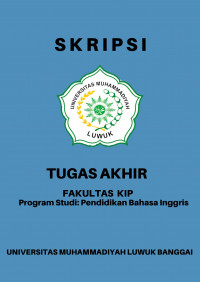
Buku
The Third-Year Students Of SMA N 3 Luwuk Proficiency In Using WH Questions And Yes/No Question
The Third Year Students of SMA N 3 Luwuk Proficiency in Using WH Question and Yes/No Question. Undergraduate Thesis. English Education Study Program, Faculty of Teacher Training and Education, Muhammadiyah Luwuk University. Supervised by ST. Marhana Rullu, S.Pd.I., M.Pd and Co-Supervised by Yuliana Mangendre, S.Pd., M.Pd. The purpose of this research was to know the-third year student of SMA N 3 Luwuk proficiency in using WH questions and yes/no questions, and the factors that influence the student's proficiency in using WH questions and yes/no questions. The subject of this research was 21 students. The researcher used the qualitative research method that using documents and interviews. The document was obtained from analyzing the third-year students' WH question and yes/no question sentence that is suitable to the answers provided and the total of the students' right question sentences is more than the students' wrong question sentences are classified into the "good" category. While the total of the students right question sentences is less than the students' wrong question sentences are classified into the "not good" category. The result showed the students' proficiency in using WH questions where, when, which, how, and whose in the simple present tense are not good. The student's proficiency in using WH questions why and how in the simple past tense is not good. The student's proficiency in using the WH question what in simple present continuous is good and the student's proficiency in using the WH question whom and who in simple present continuous is not good. The student's proficiency in using yes/no questions in the simple present tense, the simple past tense, and the simple present continuous tense is good. Afterward, the factors that influence the third-year students of SMA N 3 Luwuk proficiency in using WH questions and yes/no questions are internal factors (physiological and psychological), external factors (parents, teacher, friends, and School), and the learning approaches factors.
Ketersediaan
| UML-S.2022.0207 | SKR-2022 REF t | Perpustakaan Universitas Muhammadiyah Luwuk | Tersedia |
Informasi Detail
- Judul Seri
-
-
- No. Panggil
-
SKR-2022 REF t
- Penerbit
- Unismuh Luwuk : ., 2022
- Deskripsi Fisik
-
xiv + 114 hlm.; ilus.; 27 cm
- Bahasa
-
English
- ISBN/ISSN
-
-
- Klasifikasi
-
SKR-2022 REF
- Tipe Isi
-
text
- Tipe Media
-
-
- Tipe Pembawa
-
-
- Edisi
-
Cetakan 1
- Subjek
- Info Detail Spesifik
-
-
- Pernyataan Tanggungjawab
-
Yusfi Awaliyah
Versi lain/terkait
Tidak tersedia versi lain
Lampiran Berkas
Komentar
Anda harus masuk sebelum memberikan komentar
 Karya Umum
  Filsafat
  Agama
Agama  Ilmu-ilmu Sosial
  Bahasa
  Ilmu-ilmu Murni
  Ilmu-ilmu Terapan
  Kesenian, Hiburan, dan Olahraga
  Kesusastraan
  Geografi dan Sejarah